Full-text available Full-text available
|
|
|
|
|
|

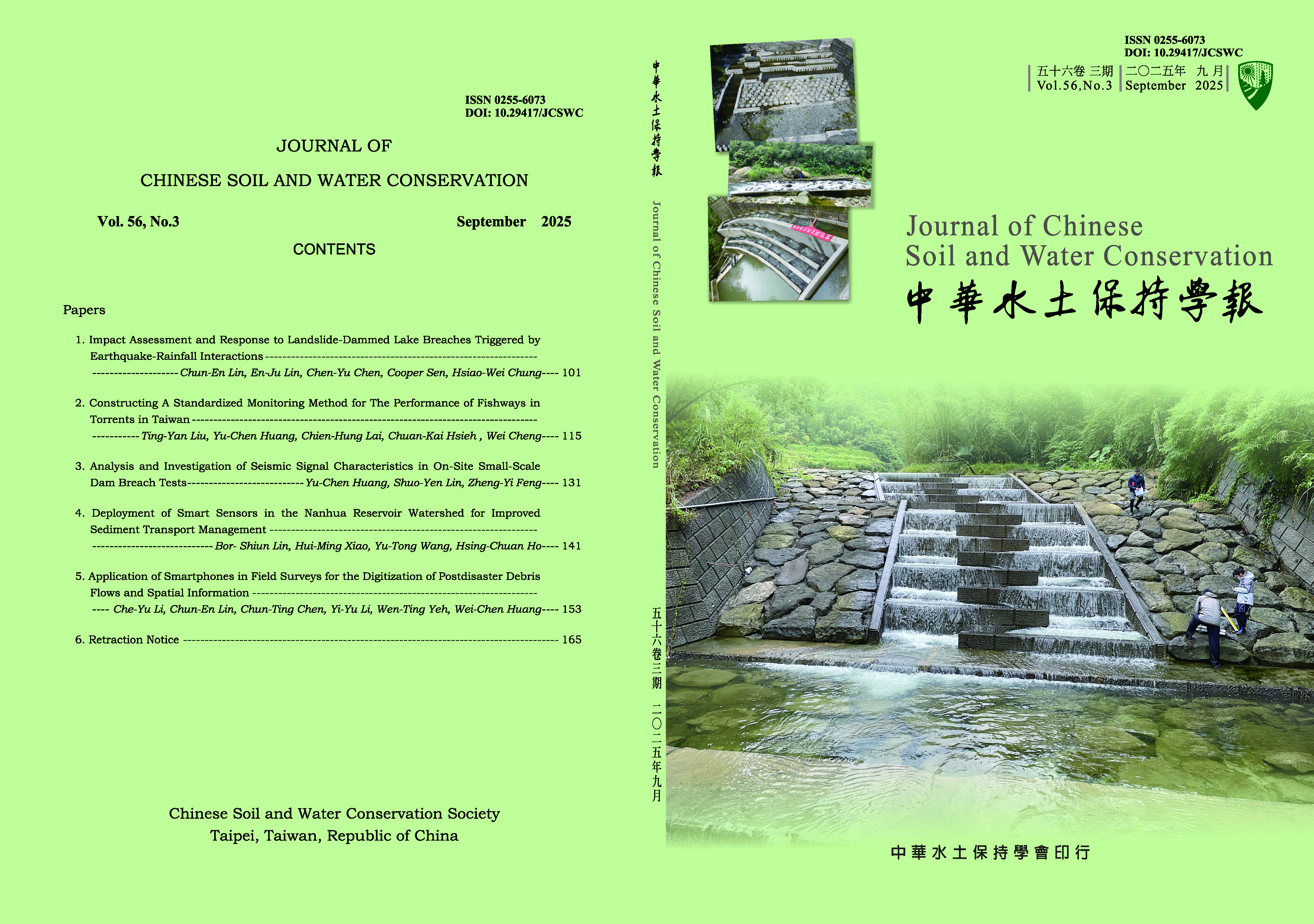
Vol.56,
No.3,
PP.101-164
|
|
| 1 |  | Impact Assessment and Response to Landslide-Dammed Lake Breaches Triggered by Earthquake-Rainfall Interactions | | | 2 | | Constructing A Standardized Monitoring Method for The Performance of Fishways in Torrents in Taiwan | | | 3 | | Analysis and Investigation of Seismic Signal Characteristics in On-Site Small-Scale Dam Breach Tests | | | 4 | | Deployment of Smart Sensors in the Nanhua Reservoir Watershed for Improved Sediment Transport Management | | | 5 | | Application of Smartphones in Field Surveys for the Digitization of Postdisaster Debris Flows and Spatial Information 56(3):153-164Che-Yu Li[1,2] Chun-En Lin[1]* Chun-Ting Chen[1,2] Yi-Yu Li[1,2] Wen-Ting Yeh[1,2]
Wei-Chen Huang[1,2]* Corresponding Author. E-mail :  jasonsinlin@gmail.com jasonsinlin@gmail.com Show preview Show preview |  PDF( 22.6MB ) PDF( 22.6MB ) | | Application of Smartphones in Field Surveys for the Digitization of Postdisaster Debris Flows and Spatial Information | 
Close | | Che-Yu Li[1,2] Chun-En Lin[1]* Chun-Ting Chen[1,2] Yi-Yu Li[1,2] Wen-Ting Yeh[1,2]
Wei-Chen Huang[1,2] |
AbstractRapid collection of postdisaster spatial information during field investigations after typhoon seasons is imperative. Persistent cloud cover and heavy rainfall make it difficult to use costly, bulky survey instruments for ground surveys in disaster settings. In this study, we used smartphones to conduct rapid field surveys and obtain spatial information for disaster mitigation and engineering design. Smartphones facilitated the digitization of engineering structures, riverbed sediments, and upstream slump areas. The results were validated using Unmanned Aerial Vehicle (UAV)-derived three-dimensional models. Our findings suggest that smartphones can rapidly generate and document three dimensional models for geometry data processing and can thus be integrated with the GIS system to enhance water and soil conservation engineering applications. Overall, smartphones represent a new, efficient approach to field surveillance and can serve as an effective tool for postdisaster surveys and engineering planning.
Key Words: smartphones, 3D model, field survey, debris flow, engineering planning | 〔1〕Agency of Rural Development and Soil and Water Conservation, MOA, Taiwan, R.O.C.
〔2〕Agricultural Technology Research Institute, Taiwan * Corresponding Author. E-mail : jasonsinlin@gmail.com | Received: 2025/06/19
Revised: 2025/07/02
Accepted: 2025/07/18
|
|
|
| |
|
|
 MAP
MAP